Proxy Server for Web Scraping: How to Choose the Right Proxy
Learn how to choose a proxy server for web scraping by comparing IP types, rotation strategies, Sticky Sessions, Geo-targeting, and other key factors.
- 1.What Really Matters When Choosing a Proxy Server
- 2.Real Problems Scrapers Face — and How Proxies Can Help
- 3.Proxy Services for Web Scraping
- 4.How to Choose a Proxy for Web Scraping
- 5.Final Thoughts
If you’re scraping public web data at scale, proxies can become an important part of your infrastructure. The quality of your proxy provider can affect how consistently your scraper works and how often requests encounter Rate Limiting, CAPTCHAs, or IP-based blocks.
There are plenty of proxy services on the market. Most advertise “high speed,” “millions of IPs,” or extremely high Success Rates. But these numbers alone do not tell you whether a provider is suitable for your specific scraping workload.
Let’s look at the main criteria for choosing a proxy server and then review several services designed for these types of tasks.
What Really Matters When Choosing a Proxy Server
The first thing to consider is the IP type.
For collecting publicly available data, Residential Proxies are commonly used because their IP addresses belong to ranges associated with regular internet service providers. For mobile-oriented platforms, Mobile Proxies using 4G/5G carrier networks may also be appropriate.
Datacenter Proxies are usually faster and less expensive, but their IP ranges belong to hosting providers and can therefore be easier for websites to identify as non-residential traffic.
| Proxy Type | Main Characteristics |
|---|---|
| Datacenter Proxy | High speed and low cost, hosting provider IP |
| Residential Proxy | ISP-associated IP and a wide range of locations |
| Mobile Proxy | Mobile carrier IP and 4G/5G networks |
The next factor is IP Rotation.
Sending a large number of requests through a single static IP can trigger Rate Limiting or IP-based restrictions. For larger workloads, look for providers that support Rotating Proxies or Sticky Sessions.
Rotation should also be configurable. Changing an IP on every request is not always the best option, especially when a website expects multiple requests to belong to the same session.
Geo-targeting is another important factor. Country-level targeting is sufficient for many tasks, but localized data collection may require city-level targeting or ASN selection. This is particularly relevant when prices, search results, availability, or other content depend on the visitor’s location.
Finally, consider integration. If your scraper needs automated proxy management, check whether the provider offers an API and supports the protocols required by your software.
For browser-based workflows, compatibility with tools such as WadeX can also be useful when you need isolated browser profiles rather than simple HTTP requests.
Real Problems Scrapers Face — and How Proxies Can Help
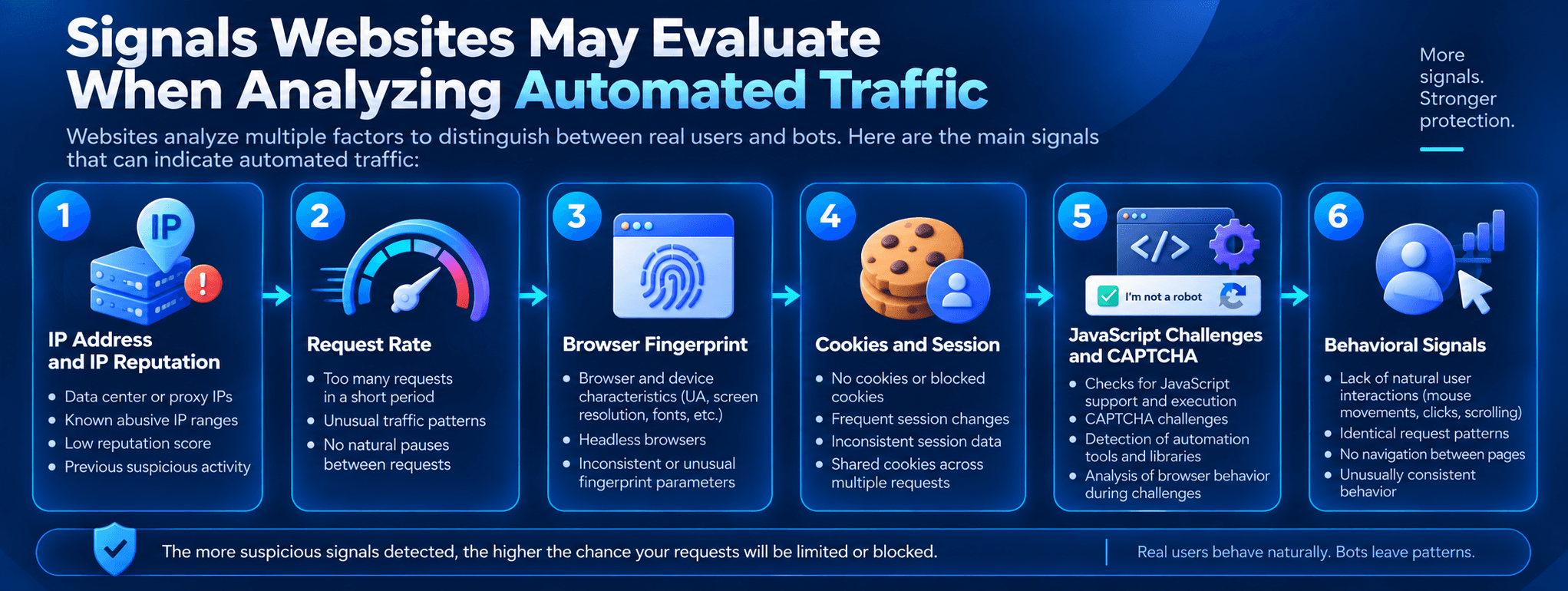
Web scraping is not limited to downloading HTML. Modern websites may use Rate Limiting, Browser Fingerprinting, CAPTCHAs, JavaScript Challenges, and behavioral signals to distinguish automated traffic from regular browsing.
A proxy server alone cannot solve all of these problems, but it can address several network-level issues.
- Too many requests from one IP can trigger restrictions. Rotating Proxies distribute requests across different addresses.
- Websites may return different content depending on location. Geo-targeted Proxies allow requests to originate from the required region.
- Some workflows require a persistent session. Sticky Sessions can keep the same IP for a defined period.
- JavaScript-heavy websites may require a real browser environment instead of basic Python
requests. In these cases, browser-based tools can be used alongside a proxy.
For browser-based scraping, WadeX can provide separate browser profiles with isolated local data and managed Browser Fingerprint parameters.
However, neither a proxy nor an antidetect browser guarantees that CAPTCHAs, Rate Limits, or other website protections will be avoided.
Proxy Services for Web Scraping
Several proxy providers offer features relevant to automated data collection, including Residential or Mobile IPs, rotation, Geo-targeting, and API access.
Before choosing one, verify the current proxy pool, supported locations, protocols, pricing, and rotation options for your specific workload.
ProxyEmpire
ProxyEmpire provides Residential and Mobile Proxies across multiple locations.
Its feature set includes IP Rotation, Geo-targeting, Sticky Sessions, usage statistics, and API-based management. This can make it suitable for scraping projects where requests need to be distributed across different IP addresses and regions.
It can be considered for both straightforward data collection and browser-based workflows where a consistent proxy connection is required.
ResiProx
ResiProx focuses on Residential and Mobile Proxy infrastructure and provides options for Sticky Sessions and granular targeting.
This type of proxy can be useful when Datacenter IPs are unsuitable for a target or when requests need to originate from specific ISP or Mobile network ranges.
For large scraping workloads, factors such as IP availability, session duration, rotation controls, and performance should be tested against the actual target before scaling.
LTEBoost
LTEBoost focuses on 4G/5G Mobile Proxies.
Mobile IPs belong to carrier networks and can be useful for collecting data from websites where location or mobile-network characteristics affect the returned content.
The service supports common proxy protocols and IP Rotation, making it suitable for workflows that specifically require Mobile Proxy infrastructure.
Decodo
Decodo provides Residential Proxy infrastructure with configurable rotation and Geo-targeting.
Its relatively straightforward setup can be suitable for developers and teams that need to integrate proxies into scripts or browser-based workflows without building a complex proxy management layer.
As with any provider, actual performance depends on the target website, requested locations, traffic volume, and session configuration.
How to Choose a Proxy for Web Scraping
The appropriate proxy setup depends on the workload.
| Task | Suitable Option | What to Consider |
|---|---|---|
| High volume of simple requests | Datacenter Proxy | Speed, cost, Rate Limits |
| Localized data collection | Residential Proxy | Geo-targeting, IP pool availability |
| Mobile-oriented websites | Mobile Proxy | Mobile ASN, 4G/5G network, cost |
| Long-running sessions | Sticky Residential / Mobile Proxy | TTL and IP stability |
| Frequent IP changes | Rotating Proxy | Rotation controls and Session Management |
Do not choose a provider based only on the advertised size of its IP pool. Connection stability, available locations, session controls, latency, API support, and pricing can matter more for an actual scraping workload.
Final Thoughts
Choosing a proxy server for web scraping involves more than comparing pool sizes or advertised Success Rates. The important factors are the IP type, rotation strategy, Geo-targeting options, session controls, protocol support, and integration capabilities.
Avoid relying on random free proxy lists for production workloads. Their IP history, availability, performance, and security can be difficult to verify.
Instead, test several providers with a small portion of your real workload. Measure request Success Rate, latency, CAPTCHA frequency, Rate Limiting, and cost per successfully retrieved page.
Then scale only after you have confirmed that the proxy configuration is stable for your specific target.
That is what makes a web scraping setup sustainable: not being “invisible,” but using reliable infrastructure, sensible request rates, consistent sessions, and proxy settings appropriate for the website you are collecting public data from.