Why UDP over SOCKS5 Matters for Antidetect Browsers
Without UDP support over SOCKS5, browsers cannot use QUIC and HTTP/3 through the proxy and must fall back to TCP. Learn why this matters for network-stack consistency.

- 1.Antifraud Systems and Network-Stack Consistency
- 2.Why Modern Browsers Use UDP
- 3.What Happens When UDP Does Not Work Through SOCKS5
- 4.Why Fingerprint Tuning Cannot Fix Missing UDP
- 5.Why SOCKS5 Becomes the Bottleneck
- 6.TCP-Only SOCKS5 vs SOCKS5 with UDP
- 7.Why UDP Matters for Antidetect Environments
- 8.How UDP Support Improves Network Consistency
- 9.Why Network Behavior Matters Alongside the Fingerprint
- 10.Conclusion
The value of an antidetect browser today is not defined by fingerprint uniqueness alone.
You can assemble a clean, modern profile, but if the network behavior underneath looks inconsistent, antifraud systems may notice it. Many checks evaluate not only what the browser reports, but also how it actually reaches the internet.
That is why UDP support over SOCKS5 has become an important part of modern proxy setups. Many proxy configurations operate in a TCP-only mode by default, while UDP may be unavailable, filtered, or unstable.
The result can be a noticeable mismatch: the profile looks like a modern device running a current browser, while the traffic consistently falls back to older protocol paths.
When the effective network stack does not match what the browser profile implies, that inconsistency can become an additional antifraud signal.
In this article, we explain why UDP matters in an antidetect browser setup, what changes when UDP is missing, and how WadeX support for UDP over SOCKS5 helps reduce one of the common sources of network inconsistency.
| Layer | Consistent Profile | Inconsistent Profile |
|---|---|---|
| Browser Fingerprint | Modern Browser Fingerprint | Modern Browser Fingerprint |
| UDP | Available | Unavailable |
| QUIC | Available when supported | Fails |
| HTTP protocol behavior | HTTP/3 when supported | Repeated HTTP/2 / HTTP/1.1 fallback |
Antifraud Systems and Network-Stack Consistency
Modern antifraud systems do more than inspect a User-Agent string, WebGL, or Canvas output.
They may also analyze network behavior, including:
- which transport and application protocols are negotiated;
- how often the browser falls back to alternative protocols;
- connection timing patterns;
- protocol negotiation behavior;
- how actual network capabilities compare with the browser profile.
If a browser presents itself as a current Chrome build but effectively operates in a TCP-only environment across sessions, that can create a mismatch.
For typical users on compatible networks, some connections may negotiate HTTP/3 where both the server and network support it.
When this never happens because the environment systematically blocks UDP, the network behavior may appear more constrained than the fingerprint suggests.
Why Modern Browsers Use UDP
Modern browsers do not usually expose UDP directly to websites for ordinary page loading.
Instead, UDP acts as the transport foundation for higher-level protocols used by the modern web.
The most important example is QUIC, which is used by HTTP/3.
HTTP/3 runs over QUIC, and QUIC uses UDP as its transport layer.
When a server advertises HTTP/3 support and the network path allows it, browsers can attempt to establish a QUIC connection.
If UDP is unavailable, QUIC cannot be established through that route.
The browser then falls back to another supported protocol, such as:
- HTTP/2;
- HTTP/1.1.
This fallback is a normal part of browser behavior.
The issue is not the fallback itself, but a persistent pattern where HTTP/3 is never available because UDP is systematically blocked by the proxy environment.
What Happens When UDP Does Not Work Through SOCKS5
When UDP cannot pass through a proxy, the browser usually does not stop working completely.
Instead, the connection degrades to alternative protocol paths.
From the user’s perspective, pages may still load normally, while the network behavior changes underneath.
A typical sequence looks like this:
- The browser attempts to establish a QUIC connection.
- UDP is unavailable through the proxy path.
- QUIC cannot be established.
- The browser performs a fallback.
- The connection continues over HTTP/2 or HTTP/1.1 using TCP.
When this behavior repeats consistently across sessions, it becomes a stable characteristic of the network environment.
Other scenarios that depend on low-latency or bidirectional communication may also behave differently.
Possible effects include:
- additional timeouts;
- repeated fallback attempts;
- less stable protocol negotiation;
- changed connection timing;
- degraded performance in some network-dependent features.
Even when the user does not notice these differences directly, they can affect the overall network profile.
Why Fingerprint Tuning Cannot Fix Missing UDP
This limitation cannot be hidden through Browser Fingerprint configuration alone.
A fingerprint can describe a modern browser environment, but it cannot change what actually happens during network transport negotiation.
You can configure parameters such as:
- User-Agent;
- Canvas;
- WebGL;
- device characteristics;
- operating system parameters;
- other browser properties.
But none of these settings add UDP support to a proxy that does not provide it.
Antifraud systems may compare declared browser capabilities with observed network behavior.
If the browser appears capable of using modern protocol stacks but systematically fails to use them because of environmental restrictions, the mismatch can become another signal describing the session.
Why SOCKS5 Becomes the Bottleneck
SOCKS5 is commonly used when proxying both TCP and UDP traffic is required.
However, using SOCKS5 does not automatically mean that UDP is available end-to-end.
Actual support depends on:
- the proxy provider;
- server configuration;
- SOCKS5 implementation;
- network filtering;
- routing conditions;
- UDP stability.
In many configurations, SOCKS5 is effectively used only for TCP.
This can be difficult to notice because websites still open and browser sessions continue to work.
At the transport layer, however, the browser may be unable to use UDP-dependent protocols and will repeatedly fall back to TCP-based alternatives.
TCP-Only SOCKS5 vs SOCKS5 with UDP
| Capability | TCP-Only SOCKS5 | SOCKS5 with UDP |
|---|---|---|
| Standard HTTP/HTTPS browsing | Works | Works |
| QUIC through the proxy | Unavailable | Possible when supported |
| HTTP/3 through the proxy | Usually unavailable | Possible when supported |
| HTTP/2 fallback | More common | Used when necessary |
| Available transport options | TCP only | TCP and UDP |
| Network behavior flexibility | More limited | Closer to a full modern network stack |
Actual HTTP/3 usage still depends on the browser, destination server, proxy implementation, and network path.
UDP support does not mean every connection will use HTTP/3.
It simply allows the browser to negotiate UDP-based protocols when they are available.
Why UDP Matters for Antidetect Environments
A modern antidetect environment is not only a Browser Fingerprint.
It also includes the network stack through which the browser actually communicates.
If the goal is to maintain a consistent browser environment, the browser should ideally be able to use the same transport capabilities that its profile implies.
That includes technologies such as:
- TLS 1.3;
- QUIC;
- HTTP/3;
- modern connection negotiation;
- current browser networking behavior.
If the proxy infrastructure systematically removes part of that capability, the effective environment becomes more constrained.
UDP over SOCKS5 therefore becomes important because it allows the browser to use QUIC and HTTP/3 when the destination and network support them, instead of forcing every compatible connection onto TCP.
How UDP Support Improves Network Consistency
Full UDP support through SOCKS5 gives the browser access to both major transport paths.
TCP can continue to carry protocols such as HTTP/1.1 and HTTP/2.
UDP can be used by QUIC and HTTP/3 when appropriate.
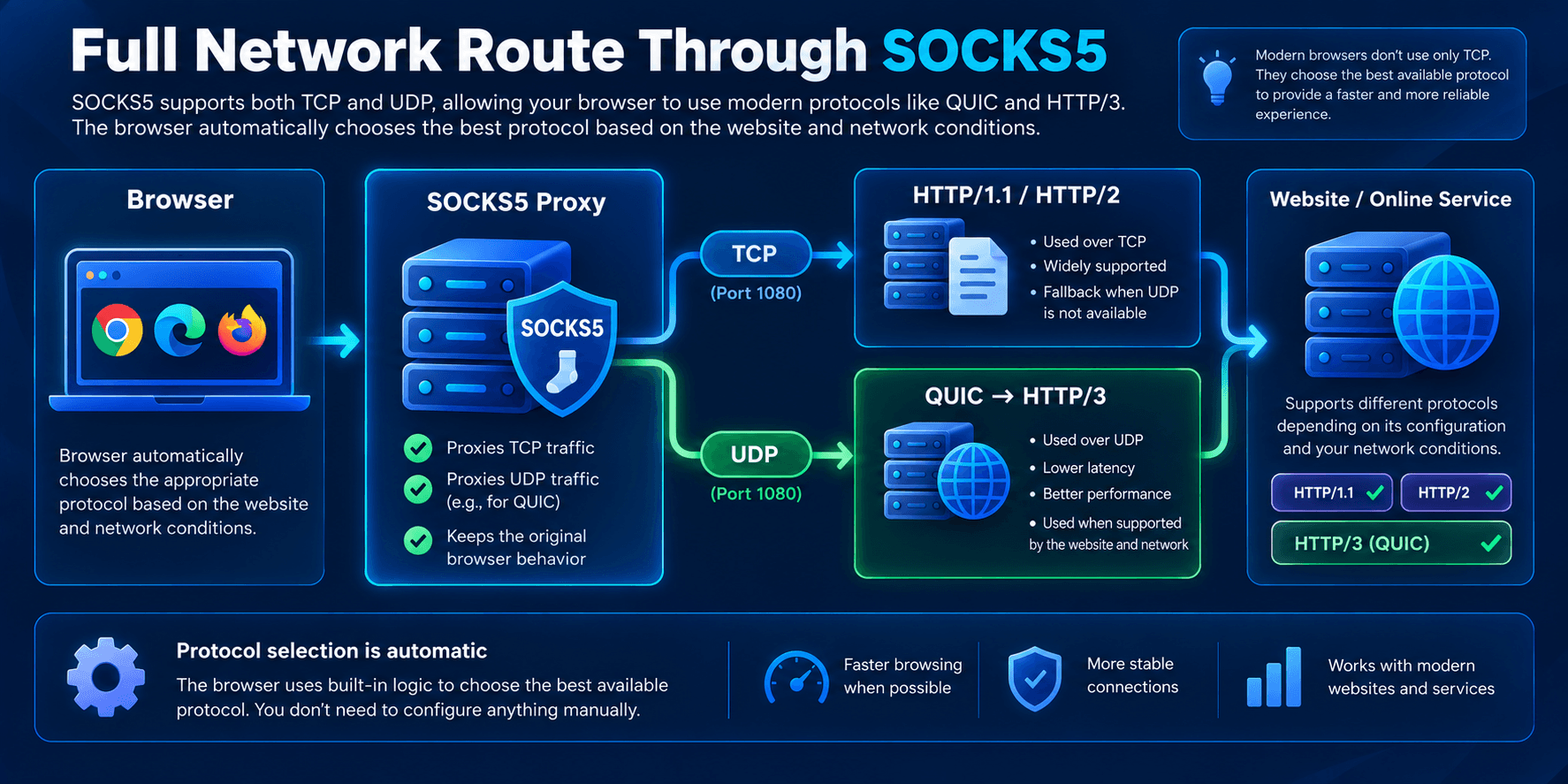
This does not force the browser to use UDP for every connection.
Instead, it removes an artificial transport restriction.
That allows protocol negotiation to depend on normal factors such as server support and network conditions rather than on a permanently limited proxy configuration.
Why Network Behavior Matters Alongside the Fingerprint
Browser Fingerprint and network behavior operate at different layers, but they can describe the same environment.
The fingerprint represents what the browser appears to be capable of.
The network stack shows which capabilities are actually available during real connections.
A consistent environment reduces obvious contradictions between these layers.
For example, a modern browser may support:
- TLS 1.3;
- QUIC;
- HTTP/3;
- current Web APIs;
- modern connection parameters.
If some of these capabilities are permanently unavailable only because of proxy infrastructure, the observed network behavior may become less representative of the declared browser environment.
That is why proxy configuration should be evaluated alongside fingerprint configuration rather than treated as a completely separate concern.
Conclusion
Antifraud systems may evaluate the relationship between Browser Fingerprint data and actual network behavior.
When UDP does not work through SOCKS5, the browser can still function, but UDP-dependent protocols such as QUIC and HTTP/3 become unavailable through that proxy route.
The browser then falls back to TCP-based alternatives such as HTTP/2 or HTTP/1.1.
Fallback itself is normal.
A consistently restricted transport environment, however, can create a mismatch between the capabilities implied by a modern browser profile and the protocols actually available to it.
UDP support over SOCKS5 helps remove that restriction.
It allows modern protocol negotiation where supported and makes the network stack more consistent with the capabilities expected from a current browser environment.